
The excerpts are cited from the U.S. Tire Manufacturers Association’s “Puncture Repair Procedures for Passenger and Light Truck Tires” wall chart, which contains the industry-recommended puncture repair procedures.
Repairs must be performed by removing the tire from the rim/wheel assembly to perform a complete inspection to assess all damage that may be present. Repairs are limited to the tread area as shown in the graphic.
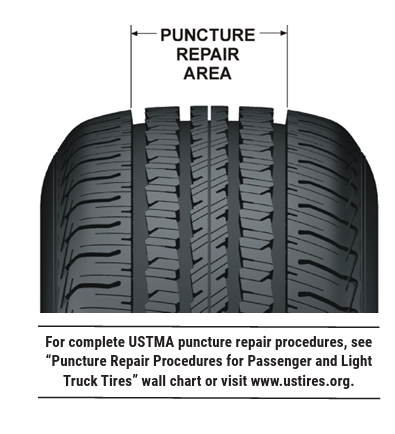
Puncture injury cannot be greater than 1/4-inch (6mm) in diameter; DO NOT make repairs where the injury damage extends into the shoulder/belt edge area OR where the injury extends at an angle into the shoulder area. If there is any question that the injury extends into the shoulder/belt edge area, then the tire must be taken out of service.
Repairs cannot overlap. A rubber stem, or plug, must be applied to fill the puncture injury and a patch must be applied to seal the innerliner. A common repair unit is a one-piece combination unit with a rubber stem and patch.
Not all tires can be repaired. Specific repair limits should be based on recommendations or repair policy of the tire manufacturer and/or type of tire service.
NEVER repair a tire that has an existing, improper repair; the tire must be scrapped.
NEVER perform an outside-in tire repair or on-the-wheel repair.
Ask your tire service professional if industry repair procedures are followed. Also, some tire manufacturers may have repair limits or restrictions for some tires, such as runflat tires and others.